Dear Liz,
I have a question for you, and I hope it doesn’t come off as a rant,
but I really can’t believe the way people come dressed to job
interviews. I’m not stodgy, as far as I know. I run a regional office
for a national firm that has about 20,000 employees. We wear business
casual clothes to work. No one has to wear a tie, but we have to look
professional.
Appropriate dress has never been an issue until just the last few
years. It’s not just Gen Y job applicants who come to their job
interviews dressed like they’re going to a club or to the beach. I’ve
had people in their 30s and 40s come to an interview in cargo pants with
no belt and a pullover shirt that looks like an upscale T-shirt (no
collar, no buttons). It is just me or has the whole ‘dress-down Friday’
thing gone too far?
The female applicants are worse than the men. Some of them wear tiny
short skirts and blouses that leave nothing to the imagination. Of
course, many of our job applicants dress perfectly and I have to tell
you, that gives them a huge advantage. I don’t mind mentoring people but
I don’t want to have to teach them what their parents should have
taught them. Can you please write about what to wear to a job interview?
Thanks,
Melissa
Dear Melissa,
Part of the problem is that when you don’t wear a suit to work the
way people used to do years ago (or the female equivalent—either a suit
or a blazer and slacks or a skirt) it’s not clear what you should wear,
and what you shouldn’t. The lines around appropriate and inappropriate
business attire have become so fuzzy that it can be hard to spot them!
A lot of people are confused. For example, the term ‘business casual’
could mean five different things to five different managers. Here are
some pointers for people who aren’t sure how to dress for a job
interview, or how to dress for work.
There is a theatrical element to work, and especially to a job
interview. When you interview for a job you are auditioning for a role,
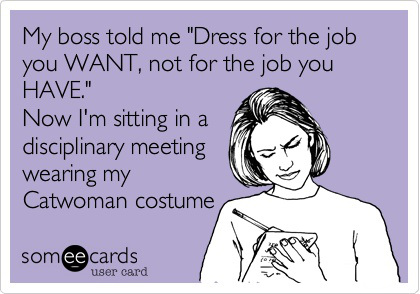
in a way. It is important to dress for the part you want! Even if you
know that the employees in a certain company wear jeans and cowboy boots
to work, that doesn’t mean you should dress casually for the interview.
Take it up a big notch. You will never go wrong with a suit (in a more
formal business environment) or a blazer and slacks or a shirt.
The only people who might find it disadvantageous to dress in a
traditionally business-y way for a job interview are creative folks or
people applying at tiny startups.
For some reason, many creative firms and some startups turn up their
noses at people who dress traditionally on their interviews. I know
this because the people who do their hiring write to me about it. They
say “It’s not our culture to wear suits and ties, and anyone who wants
to work at our little, funky firm should understand that.”
I feel bad for any job-seeker who gets rejected for a job because
they dressed too nicely for a job interview. Oh well—if some
people don’t get you, they don’t deserve you!
If you know that you’re applying at a traditional firm meaning any
law firm, accounting firm, government agency, healthcare or financial
services firm, dress the part, all the way!
That means a suit for men, and not a hipster suit ripped from the
pages of an Italian high-fashion magazine but a traditional one that
fits you well. Wear a pale-colored or white shirt and make sure your
shoes fit the profile. Women can wear a suit or slacks or a skirt with a
blouse and something on top of it, like a sweater or a jacket.
It’s fine to look stylish, but you don’t want to show any extra skin
or look too flashy. Your goal is to look professional, not come to the
interview dressed for an evening on the town.
If you’re applying for a job at a less-conservative firm, you can
brighten your colors if you want and men can consider wearing a jacket
and slacks instead of a suit cut from one piece of cloth. That’s about
as far as I’d want you to go toward business-casual attire on a job
interview.
Once you get the job, you can choose your outfits based on what your
co-workers are wearing. Never, ever be the most casually-dressed person
in your workplace. No one wants to lecture you on appropriate attire, so
don’t put anyone in that position!
If you interview for a job you want and don’t get it, don’t lose out
on the job because you didn’t dress the part at the job interview. You
know what they say: First impressions are important. No matter how
creative and unique your personality is, your attire should be
businesslike. The late Beat author William Burroughs was as wild as they
come, and he always dressed in grey flannel suits. Burroughs said
(referring to the squares) “I want to see them coming. I don’t want them
to see me coming.”
Let your worldview and your great ideas show your interviewer what an
out-of-the-box person you are—not your interview clothes! Dress for the
part you want at a job interview, and even once you’ve got the job. If
you’ve ever spent time onstage you know that a costume helps you step
into character. It doesn’t work any differently in the business realm!
All the best,
Liz
Liz Ryan is the CEO and founder of Human Workplace. Follow her on Twitter and read the rest of her Forbes.com columns here.
Comments
Post a Comment