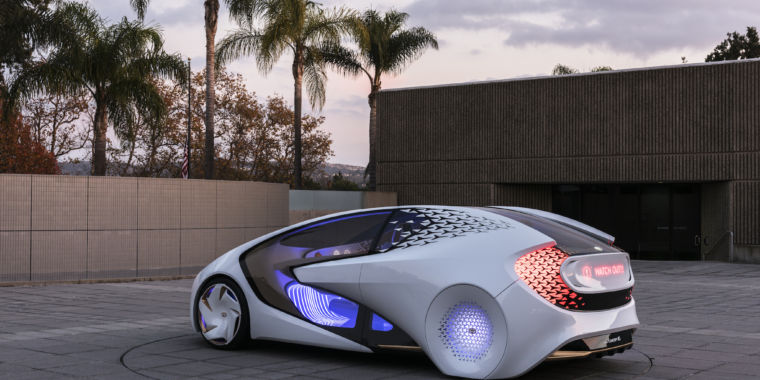
Appearing like a large dimpled egg, the
Concept-i autonomous car was unveiled by Toyota at the Consumer
Electronics Show in Las Vegas as a true design concept; a canvas
stitched with ideas for a warmer, more engaging, connected autonomous
car of the future. Its hypothetical on-sale date is 2030, although
Toyota freely admits that it has virtually no plans to put the Concept-i
into production.
The most problematic trend in autonomous cars,
Toyota says, is that they simply do not appeal to the touchy-feely
sentiment we humans have when it comes to our emotional connection with
cars. Fully autonomous concepts have thus far been cold, distant, and
purgatorial, Toyota posits. No more. Toyota's future eggmobile puts a
cheeky face on the future of driving and is even fitted with Yui, a
synthetic AI car butler/pal/servant who will learn your likes and
dislikes behind the wheel. Just as importantly, though, the Concept-i is
also drivable by humans, so you need not feel like luggage all the
time.
Clearly, Toyota already perceives a backlash
against AI and potentially intrusive technologies into our lives, one
extension of which is the soulless, flavorless, robot-car that the
automotive world is racing toward.
"This is what Toyota thinks driving will look
and feel like in 2030," declared Ian Cartabiano, Toyota's CALTY design
studio chief in California. "We're going to have autonomous cars, but we
want them to be fun while they're autonomous." In other words, with
this concept car, Toyota envisions a friendly future, not a foreboding
one.
This is sharply ironic coming from a brand
many feel offers boring cars, but it wasn't always thus. Let us not
forget the 1980s and early '90s, when Toyota birthed not only the Supra,
but the MR2. It took WRC Rally competition so seriously in 1995 that it
famously cheated
by inventing an extra air inlet passageway in its turbochargers that
was essentially invisible under inspection. This generated about 50 more
horsepower than competitors and got the company banned from the WRC in
1996. And the 24 Hours of Le Mans
was Toyota's for the taking
in 2016, until a connector failure between the turbo and intercooler
hobbled the car, literally on the last lap. So, yes, Toyota can be a
kind of sleeping giant, and someone inside the giant—perhaps named
Yui—is trying to poke it awake.
From a pure design standpoint, Cartabiano
rejects the notion of a smart phone or tablet with wheels, something he
finds all too common in autonomous future-car thinking. Toyota's guiding
design principle, therefore is what they call "kinetic warmth."
"The Concept-i imparts movement, but in a very
friendly way," Cartabiano said. "We want to combine AI, but we also
want a different level of warmth. We want to retain the fun of driving,
of engagement and the human hand. We seek liveliness, sculpture,
emotion, and warmth."
Usually, car design begins with the exterior,
but Concept-i started from the inside, with Cartabiano's team spending
five months asking themselves "what is the future?" and forging a
philosophy before even sketching a single thing.
They also forbade sketching cars until
necessary. Cartabiano directed team designers to look to art, sculpture,
furniture, and large-scale installations for inspiration.
"Once we set that kinetic warmth concept
inside and out, and we set the notion that Yui would move around the
car, that allowed us to not only work on the user experience, but it
gave us a different form language," he told Ars.
Interestingly, Concept-i actually breaks the
3D plane from traditional cabin space to the outside, bringing both
outside in and inside out.
All artificial intelligence personae need a name, from HAL 9000 in 2001: A Space Odyssey
to personal assistants like Alexa and Siri. The Concept-i's is called
Yui, who appears in the center of the dashboard like an animated
parabola with a circle or funny eye in the middle, presenting
information all around the car, inside and outside. Again, accent on
friendliness was the guiding light. The team considered 3D graphics and
holograms but instead chose a simple, cartoon-like visage. It's fully
flexible and conveys mannerisms and emotion, calling attention to
certain things when needed.
Again, CALTY Design Chief Ian Cartabiano: "Yui
must communicate not only with the driver, but with other passengers in
the car, plus others literally outside the car because the relationship
of humans and cars is not limited to the inside. Pedestrians, other
cars, and the people in those other cars have a need for information, as
well."
When the Concept-i awakes, a puck-like shape—a
momentary embodiment of Yui—rises from the center console prompting you
to engage a start function. But Yui cannot be held to one location. She
appears on all the interior surfaces, conveying information, depicting
scenes, even flashing a moving arc along the headliner to the back of
the car when she detects an obstacle to backing up before the car moves,
drawing your attention (and that of the passengers) to the rear of the
car.
One impressive part is that all these graphics
are born out of the panels on which they appear; they are not projected
onto them. Yui also relocates to exterior LEDs, communicating
externally to pedestrians, bicyclists, or other car occupants: "Watch
out!!" "Turning right." (Can a Yui that reminds you to "Eat your
veggies!!" be far behind?) Yui will also transport to your smartphone.
But Yui is not limited to a figure inside the
car. Eyes in the place of headlamps at the front of Concept-i lurk
beneath the paint so that when you come close, they open up like
eyelids. Doors communicate with you, forming messages: "Hello."
"Goodbye." "Tie your shoes." Shades of The Hitchhiker's Guide to the Galaxy's Heart of Gold?
The interior and exterior are lit with two
distinct colors, depending on driving mode: purple for self-driving and
green for human-driving. Design Chief Cartabiano told me later that all
these softer indicators are borne of a very old Japanese principle of
hospitality, "omotenashi."
Omotenashi literally means "the Japanese way
of treating a guest," but it also provides context. Most importantly, it
lends a welcoming spirit with warmth, understanding, and respect. The
principle of Omotenashi appears and recedes almost invisibly.
Toyota's Concept-i hints at a friendlier
future in autonomous cars and artificial intelligence than many fear.
Imagine if it could actually be built.
Listing image by Toyota
Comments
Post a Comment