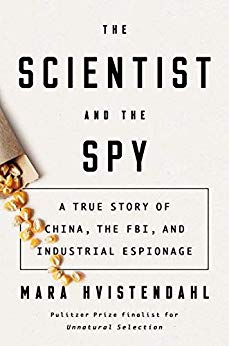
The Scientist and the Spy: A True Story of China, The FBI, and Industrial Espionage
by Mara Hvistendahl
Despite
ongoing concerns regarding their long-term safety and environmental
impacts, genetically modified foods are massive money makers for the the
companies that develop and market them. They're worth even more to the
companies willing to lie, cheat, bribe, trespass and steal to get their
hands on even a few precious samples.
In
The Scientist and the Spy,
author Mara Hvistendahl expertly walks readers through the fascinating
history of industrial espionage and how the practice has impacted (as
well as been effected by) the industrial and information revolutions --
all through the lens of a daring GMO corn heist perpetrated by Chinese
nationals in America's heartland. I never figured that corn was such a
hot commodity!
Industrial espionage is as old as
industry itself. The oldest known recognition of intellectual property
rights came thousands of years ago, in the ancient Greek city of
Sybaris, when chefs presiding over extravagant feasts complained of
scheming rivals stealing their recipes. The solution city leaders
devised was to grant cooks exclusive rights to their concoctions for one
year. Back then the target was literally the secret sauce. In the
intervening centuries, as our choicest products progressed from gravy to
engines to supercomputers, the metaphor remained.
The Byzantine
Empire, imperial China, the Ottomans, Great Britain, America: Theft of
one nation's technologies by another marked the transfer of power from
one empire to the next almost as routinely as bloodshed. For most of
history, industrial espionage was regarded as something that nations
just did, much like spying for political or military secrets. The victor
was the one who stole the spoils, while the act of theft was typically
forgotten. History remembers the East India Company and its vast
colonial tea plantations, but not the British botanist who journeyed to
China's Fujian province improbably disguised as Qing nobility, his head
shaved except for one long braid, to purloin the technique for
processing tea leaves. It remembers delicate French white and blue
ceramics, but not the Jesuit priest who traveled to China's imperial
kilns to filch the technique for making hard- paste porcelain. And it
remembers the industrialist Francis Cabot Lowell, father of Lowell,
Massachusetts, but not his 1810 trip to England and Scotland, where he
spent weeks touring factories and memorizing the blueprints that would
allow him to "invent" the power loom on the western side of the
Atlantic.
In most parts of the world until the mid-1990s,
companies dealt with trade secrets theft through civil lawsuits. No
international treaty or agreement explicitly tackled industrial
espionage. In the United States just one federal statute did, and it
only covered theft by a government employee. Then, a year before Mark
Betten started his career at the FBI, President Clinton signed into law
the Economic Espionage Act, which made trade secrets theft a federal
crime. The 1996 law represented a seismic shift: It was the first time
in American history that attacks on American business were branded as a
national security threat.
The act was born in the wake of the Cold
War, as intelligence leaders cast about for a new mission. In some ways
industrial espionage was a logical choice. Technologies of all sorts
were rapidly increasing in value, making them attractive to spies. The
dawn of the internet and breakthroughs in global communications,
meanwhile, provided more weak points than ever before for siphoning off
information.
At the time, policy makers were particularly
concerned about France, whose secret service chief had been blunt about
his interest in obtaining American economic secrets. But critics
suspected that the drive to designate industrial espionage as a federal
crime was also about the intelligence agencies' interest in
self-preservation. The fall of the Iron Curtain had made the mandate of
the FBI and CIA unclear. Newspapers were running headlines like cold
war's end brings enemy gap and cia— costly, inept, anachronistic. After
he was sworn in as CIA director in 1991, Robert Gates had promptly
written on a notepad, "New world out there. Adjust or die." Gates became
a staunch advocate of the Economic Espionage Act.
Legal scholars
pointed out that state law was deemed sufficient for a range of
high-stakes crimes, including many types of murder. Why did trade
secrets theft deserve different treatment? Senator Bill Bradley worried
that economic espionage could become "a pretext for a new program of
counterintelligence surveillance by the FBI of either foreigners or
Americans." Others simply thought that the threat was inflated. "The law
gives the FBI not only a cold war reason for being but a reason for
using once again the formidable methods of the cold war," journalist
Robert Dreyfuss wrote in
The New Republic.
Whatever the
reality, a consensus built in Washington that technical information was
so dangerous a weapon when in the hands of a foreign company or
government that America needed tougher tools to deal with it. The 1990s
was an era of intense globalization and consolidation, and multinational
corporations were advancing into new markets where they faced foreign
competitors. Stiffer penalties provided a way to hobble those
competitors in court, or at least bog them down in costly litigation.
And because economic espionage was a federal crime, corporate lawyers
could step back and let federal prosecutors bring charges on their
companies' behalf.
Large corporations were among the law's biggest
backers. Some even felt that the United States should go further, by
actively spying on other countries' firms— a proposal that was rejected
mainly because it was impractical, not because of strong moral
objections.
In the years following the Economic Espionage Act's
passage, the Justice Department brought cases involving cancer drugs,
software programs, and razors. Then, on September 11, 2001, terrorists
associated with al- Qaeda hijacked four commercial airplanes and steered
two of them into the World Trade Center. As the United States waged an
assault on terrorism, economic espionage faded from view.
In the
late 2000s, when trade secrets theft investigations picked up again, the
focus shifted to China. Western elites agreed that while other
countries, including nineteenth-century America, had relied on
industrial spying to advance technologically, China took it to a new
level. "In a manner of speaking, the United States stole books; China
steals libraries," quipped James A. Lewis, an expert on industrial
espionage at the Center for Strategic and International Studies. It
helped that China's rise as a global economic power had coincided with a
democratization of spy tools. The 160-kilobyte floppy disk, just small
enough to slip into a purse, was replaced by the 128- gigabyte flash
drive, with nearly 1 million times more storage compressed into a gadget
as slim as a pinky. Clunky recording devices gave way to sophisticated
spyware that allowed for commandeering the microphone and camera of a
user's smartphone.
Unsophisticated cyberattacks could expose whole
company servers to plundering. In 2009, as Mark Betten moved into his
second decade at the FBI, the bureau created a dedicated Economic
Espionage Unit.
On May 2, 2011, President Obama announced that
Osama bin Laden had been killed in an American military operation in
Pakistan. The menace of terrorism, it appeared, had subsided. The
emergence of Islamic State militants would later shake this sense of
security, but in the meantime the national security establishment moved
on to a different threat: economic espionage. The day after Obama
announced bin Laden's death, the Pioneer contract farmer spotted a
Chinese man in a cornfield in Tama County, Iowa.
From
SCIENTIST AND THE SPY: A True Story of China, The FBI, and Industrial
Espionage by Mara Hvistendahl published on February 4, 2020 by
Riverhead, an imprint of Penguin Publishing Group, a division of Penguin
Random House LLC. Copyright © 2020 Mara Hvistendahl.

Comments
Post a Comment