Immobilizer security flaw leaves millions of Toyota, Hyundai, and Kia cars vulnerable to theft
on
Get link
Facebook
X
Pinterest
Email
Other Apps
Affected owners might need to visit a dealership for remedying the problem
By Humza Aamir
In context: For all the conveniences
they provide, keyless entry systems in cars have been subjected to relay
attacks for several years, requiring carmakers to beef up security
measures against such hacks that generally require a few hundred dollars
of equipment to execute. A new key-cloning technique developed by
security researchers from KU Leuven, Belgium, and the University of
Birmingham, UK, makes use of vulnerabilities in DST80, a Texas
Instruments encryption system found in car immobilizers used by several
major manufacturers, potentially enabling hackers to drive away with the
vehicle.
With security being a perpetual leapfrog of finding loopholes and
patching systems across several industries, it's not surprising to see
modern tech-laden cars being subject to the same process. A new
discovery, however, might be a pickle to fix for Toyota, Hyundai, and
Kia, companies whose decade-old and more recent models have been found
vulnerable to a key-clone attack.
Although the final objective is the same, the cloning technique differs from a relay attack
in the way that it requires a hacker to swipe an inexpensive Proxmark
RFID reader/transmitter device with a key fob that's using DST80 inside,
reports Wired.
The two-step process involves extracting the secret cryptographic
value of the key fob through the exploit, which impersonates the RFID
device as the key inside the car and allows for disabling the
immobilizer. As the hack only affects the immobilizer and not the
keyless entry system, the hacker still needs to start the engine by
turning the ignition barrel.
That's where the second step of hot-wiring comes in, which the
researchers say can also be done with a well-placed screwdriver in the
ignition barrel, techniques used by car thieves before the immobilizer
came in. "You're downgrading the security to what it was in the '80s,"
notes computer science professor, Flavio Garcia, from the University of
Birmingham.
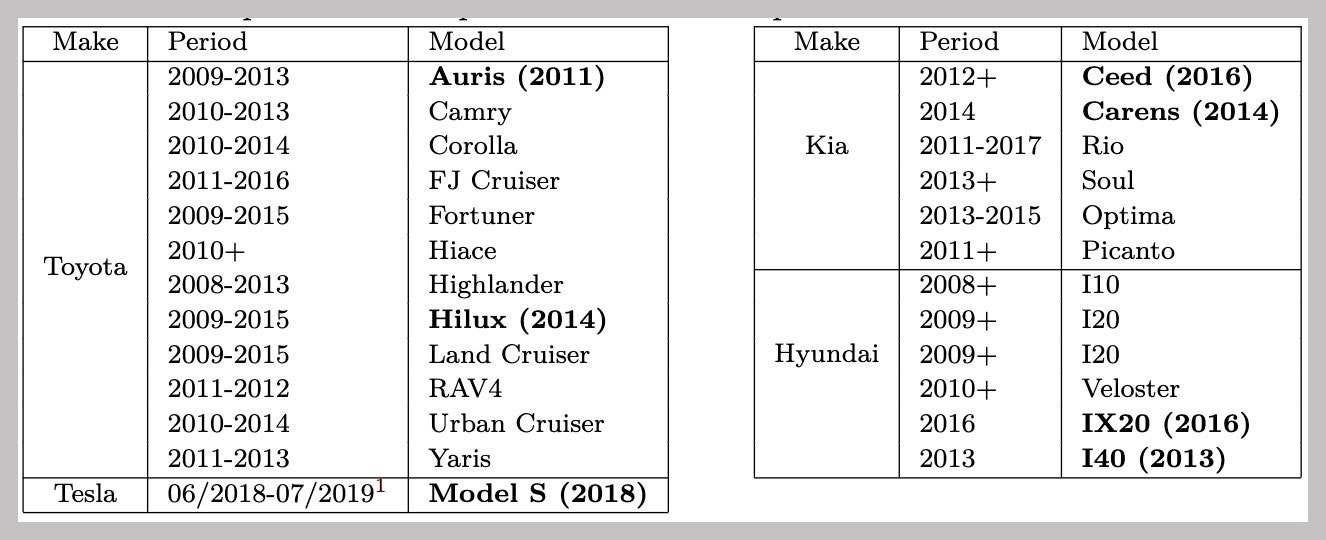
Out of all the affected cars, only Tesla issued a software fix for its Model S.
Popular cars like the Toyota Camry, Corolla and RAV4 are vulnerable
to this hack, along with several models from Kia and Hyundai appear on
the list. The issue also affected the 2018 Model S, which the
researchers say was patched by Tesla through an OTA update last year
when the DST80 vulnerability was reported to the company.
It's worth noting here that the flaw doesn't lie with DST80 itself
but in how carmakers chose to implement the system. Toyota, which
acknowledged this vulnerability, had fobs transmitting cryptographic
keys based on the cars' serial number, while Hyundai and Kia made
guessing the key easier (and quicker) by using 24 bits of randomness
instead of 80 bits offered by DST80. The researchers were able to
retrieve this information by getting a collection of immobilizer ECUs
from eBay and reverse-engineered their firmware to analyze how they
communicated with the key fobs.
"The described vulnerability applies to older models, as current
models have a different configuration," said Toyota, in a statement to
Wired, adding that "this vulnerability constitutes a low risk for
customers, as the methodology requires both access to the physical key
and to a highly specialized device that is not commonly available on the
market." to which the researchers disagreed, while Hyundai noted that
none of its affected models are sold in the US and reminded customers
"to be diligent with who has access to their vehicle’s key fob."
Comments
Post a Comment