As rumaki reo classes and other kura reo begin again for the
year, RNZ journalist Te Aniwa Hurihanganui reflects on coming full
circle back to te reo Māori.
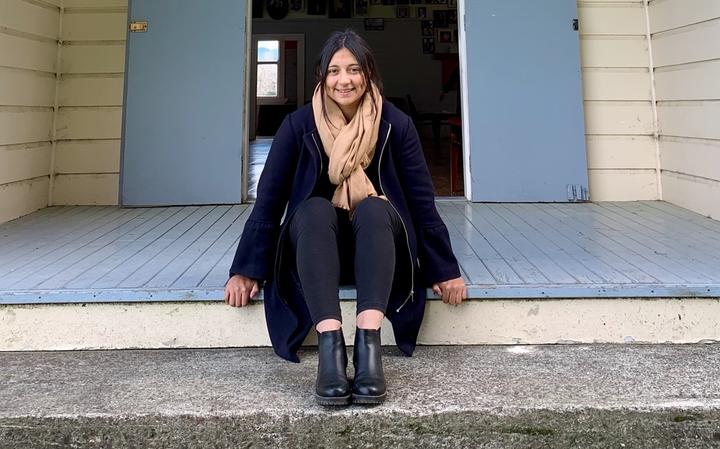 RNZ reporter Te Aniwa Hurihanganui.
Photo: RNZ
RNZ reporter Te Aniwa Hurihanganui.
Photo: RNZ
Why did I lose my reo?
That's the question I have been asking myself since I enrolled in Te
Pōkaitahi Reo, a full-immersion te reo Māori programme, at the beginning
of the year. Answering that question, as it turns out, has required a
lot of reflection. Thirteen years ago, te reo Māori flowed from my mouth
confidently and freely; I was a fluent speaker. Today, I am not. Trying
to understand exactly why has been confronting, but by sharing my
journey hopefully people like me, who were lucky enough to grow up with
te reo but unable to hold onto it, can know they are not alone.
When I think about my earliest memories of te reo, I think about my
dad. He is the proudest Māori I know. The type of guy who only wears
'Haka' brand tops and cuts slits into the sides of his shorts to show
off his pūhoro. He has absolutely no shame, and our family quickly
became known in every neighbourhood we lived in because dad sung waiata
at the top of his voice without a care in the world.
My dad is a talented composer; he's written many waiata for kapa haka
and theatre shows around the country. When I was little, he spent his
nights recording new waiata in our living room. From the outside, I'd
press my ear against the door and listen, memorising every word and
quietly singing along with him.
Dad sung waiata during car rides to kōhanga reo, and again years
later at my kura when he became a part-time kapa haka tutor. He made te
reo Māori the centre of my universe, and I felt so proud knowing it was a
passion we both shared.
When my parents decided to start afresh and move our whānau to a new
town, they made the difficult decision to enrol my younger brother and
myself at a mainstream primary school. We left our familiar social
circles where te reo was always present and entered a te reo-absent
world. It was overwhelming and lonely, and I struggled to find my
footing in this new environment.
On my first day at a new school, my teacher shook my hand and asked
me to repeat my name three times before deciding it was too difficult
and that she would call me something different entirely.
"Tee-ah-nah-wah" became my new name for the rest of the year.
And then came my very first English spelling test. I stumbled over
every question because there were words I'd never seen before; half the
letters on the page didn't even exist in the Māori alphabet. Handing in
that test was nerve-wracking, and I prayed that I'd gotten at least one
word correct.
"What is this?" My teacher asked frowning.
My heart pounded in my chest.
"You stupid girl," she said, glaring down at me. "You don't know how to spell the word 'sometimes'?"
The other kids looked at me and laughed. Not knowing what to do or
what to say, I wished the ground would swallow me whole but my teacher,
who apparently hadn't finished humiliating me took one last stab.
"You have the spelling age of a seven-year-old," she said. I was ten at the time.
Tears welling in my eyes and a lump forming at the back of my throat,
I scuttled back to my chair at the back of the room with my head down,
vowing that this would never happen again and that soon I'd be like
everyone else.
I carried that memory with me every day. It made me resentful, and I
blamed kōhanga reo and kura for my incompetence. In later years, when te
reo Māori was offered as an optional subject at high school, I never
picked it. I could have joined kapa haka too, but by then I was no
longer interested.
As I grew older there were moments, glimmers, of that little girl I
used to be who loved speaking and singing te reo. At whānau gatherings,
where te reo was spoken often, something inside me lit up. I felt it
whenever my dad would sing, or when I heard karakia or karanga on my
marae. Or every time my older brother competed at the Manu Kōrero Speech
Competition and recited our whakapapa in his tauparapara, or performed
on stage at Te Matatini. Somewhere deep within, my reo and the desire to
speak it again lived on.
My biggest turning point came at university, when I learnt about the
history of Aotearoa and the hardships my tūpuna faced. Through their
experiences I began to understand what racism looked like, and for the
first time in my life I realised how my own experiences of racism had
shaped me.
When I completed my journalism degree, I applied for the Henare Te Ua
Internship at RNZ, a year-long programme for aspiring Māori
broadcasters. Although I'd reached a point in my life where I finally
felt grounded in my culture and my identity again, I wasn't confident
I'd get the job because they were ideally looking for someone fluent in
te reo.
During my interview, journalist Mihingarangi Forbes asked the question, "How confident are you speaking Māori?".
I talked about the girl who loved her language, who grew up at
kohanga reo and kura, but who had lost her reo along the way. I was
certain that she was going to tell me I wasn't right for the job, but
instead she simply smiled and said, "Kei roto i a koe." It's inside of
you.
It's inside of you.
And the memories came rushing back; the child perched outside the door listening to her dad sing.
It's inside of you.
And the whakamā disappeared, the 10-year-old finally let go of the cruel words of her primary school teacher.
And I spent the next three years immersed in Māori current events. I
watched iwi leaders speak at Waitangi on Waitangi Day and I covered the
dispute at Ihumātao. Everywhere I went I heard my language spoken and
that small spark within me turned into a blaze and I knew it was time to
reclaim my reo.
There's a saying my older brother and his partner created: "Whakairotia tō whare kōrero ki ngā kupu a ō tupuna".
It means, "adorn your house of language with the words of your ancestors".
And that's where I'm at now, about to embark on a full-immersion te
reo Māori programme and I couldn't be more terrified or excited. It's
time and I'm ready. I'm ready to uphold the legacy my dad instilled in
me at a young age. I'm ready to re-adorn my house of language with the
words of my ancestors.
* This article originally appeared on
The Spinoff.
Comments
Post a Comment