Why it matters: Car infotainment
software such as Android Auto and Apple CarPlay is incredibly popular
among drivers, but a new study suggests that interacting with vehicle
infotainment systems can impair reaction times more than alcohol and
cannabis.
A
simulator study
undertaken by TRL on behalf of IAM Roadsmart—the UK’s largest
independent road safety charity—the FIA, and the Rees Jeffreys Road
Fund, showed how much drivers’ reaction times slowed based on different
scenarios.
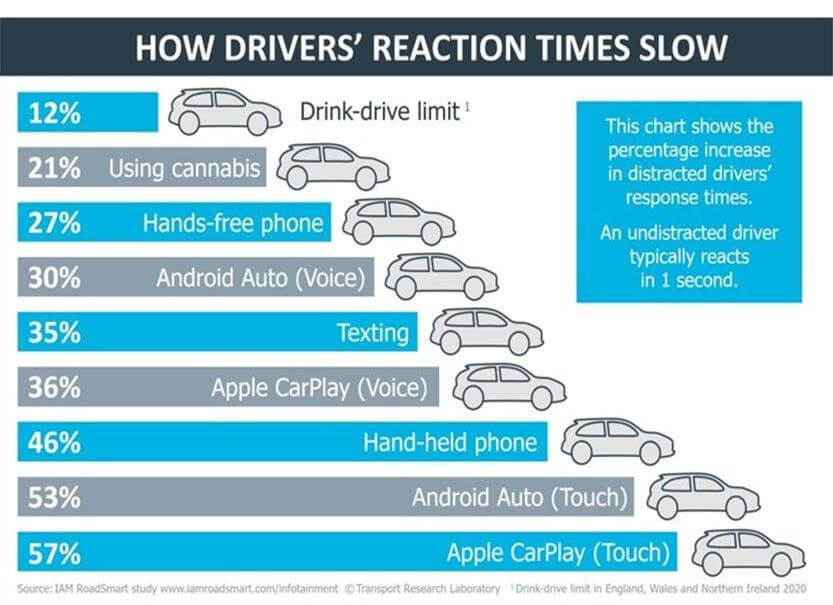
It typically takes an undistracted driver one second to react to
something. That increases by 12 percent when they’re at the drink-drive
limit, 21 percent if they’ve been using cannabis, and 35 percent if
they’re texting. When using Android Auto (touch) it goes up to 53
percent, and Apple CarPlay is even higher—57 percent.
The study found that drivers interacting with their infotainment
touch screens increase their vehicle’s stopping distance by between four
and five car lengths. They also take their eyes off the road for up to
16 seconds while driving. “Participants underestimated by as much as 5
seconds the time they thought they spent looking away from the road when
engaging with Android Auto and Apple CarPlay via touch control,” wrote
IAM Roadsmart.
Additionally, drivers interacting with Android Auto or Apple CarPlay
struggled to keep their vehicle’s position in a lane, swerving out of
place by up to 21 inches. They also failed to maintain a constant speed
and distance from the vehicle in front.
While using voice commands did improve reaction times compared with
touching infotainment screens, this still increased the non-distracted
time by 36 percent.
IAM Roadsmart is calling for further testing and the introduction of
new industry standards for infotainment systems to help minimize driver
distraction. It advises owners to use them in the safest possible way,
including setting everything up before starting a journey.
Comments
Post a Comment