By SETH J. FRANTZMAN6-8 minutes
Noor was now orbiting 425km (264 miles) above the Earth's surface, the Guards said on their website.
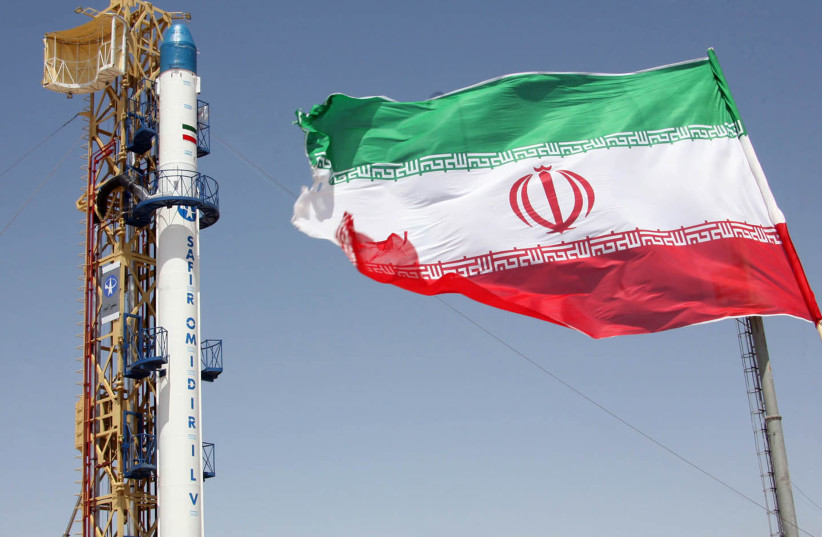
The Safir satellite-carrier rocket, which was designed
for Iran's Omid satellite, is seen before launch at Iran's space centre
in Tehran in 2009
(photo credit: REUTERS)
Iran’s Islamic Revolutionary Guard Corps say they successfully
launched the country’s first “military satellite” into an orbit around
earth. This comes after Iran announced new anti-ship
missiles with a range of 700km and
drones
that have a range of 1,500km and may be armed with anti-tank missiles.
Iran is on steroids in its attempt to show off its military capabilities
at sea, in the air and in space.
Israel strongly condemned Iran’s
attempt to launch the military satellite, noting that the Islamic
Revolutionary Guard Corps, is a Foreign Terror Organization, designated
by the US. “Today’s attempt at launching a satellite is just a façade
for Iran’s continued development of advanced missile technology. Both
Inter-Continental Ballistic Missiles (ICBM's) and missiles that can
carry a nuclear warhead,” a statement by the Foreign Ministry said.
1/4
Israel strongly condemns Iran’s attempt to launch a military satellite
by its Revolutionary Guard’s, a Foreign Terror Organization, designated
by the US.
Today’s attempt at launching a satellite is just a façade for Iran’s continues development of advanced missile technology pic.twitter.com/P7mIzpEDNn
— Lior Haiat (@LiorHaiat) April 22, 2020
“Today’s launch is a breach both of Security Council’s resolution 2231,
and Iran’s previous commitments to the international community. The
Iranian regime continues to focus its efforts on military aggression,
instead of mending its failure in dealing with the Coronavirus’s
outbreak, that has affected tens of thousands of Iran’s citizens. Israel
calls upon the international community to condemn this latest launch,
and impose further sanctions on the Iranian regime. All in order to
deter it from continuing such dangerous and opposing activity,” Israel’s
statement said.
Iranian media were plastered with images
Wednesday morning of the large white rocket with an Iranian flag
preparing to launch. Iran has a mixed record shooting things into space.
It has an advanced program that has launched satellites in the past,
including joint research projects with Russia, China and Thailand. Its
first breakthrough was Omid, a domestically made satellite that was a
major achievement for Tehran’s satellites. It was sent into orbit in
2009 on a homemade missile. Iran launched imaging satellites in 2011 and
2012. However, more recent launches have generally failed to put
satellites in orbit.
Iran has an advanced rocket program with a
large variety of ballistic missiles. Combining those with its desire to
be a space power has helped it achieve success. However it appears that
it suffered a setback in August 2019 at its Semnan launch site when a
rocket appeared to fail. US President Donald Trump tweeted photos of the
failure. Iran thus had at least three failures in 2019. It also appears
that Iran’s space program increased after the Iran Deal was signed
after years of not achieving at the levels Tehran wanted. The recent
attempts in 2019 and 2020 are evidence of this. It comes in the context
of all the programs Iran is ramping up, including the nuclear program,
long-range drones, missiles and ballistic missiles, as well as weapons
trafficking of drones and precision ordnance to Hezbollah, the Syrian
regime and Houthis.
Of interest in the April 22 launch is that
Iran specifically says this satellite was launched by the IRGC. The IRGC
is Iran’s revolutionary guards, sometimes viewed as an “elite” force,
but more accurately it should be seen as the way in which paramilitary
revolutionary theocratic elements have swallowed the Iranian state. The
IRGC has displaced not only part of Iran’s economy, foreign policy,
intelligence services and government, but also the army, air force and
now space program. The IRGC inserts itself in every crisis from
coronavirus to flooding. It also harasses the US Navy in the Persian
Gulf and is responsible for threatening Israel.
IRGC head Salami praised the launch in Tasnim and Fars news in Iran as an important achievement.
"We
have made a leap in the field of expanding territory and strategic
intelligence....Today, we can see the world from space, and this means
expanding the strategic intelligence of the powerful defense force of
the Islamic Revolutionary Guard Corps," he said. "The deployment of this
multi-purpose satellite in space, both in the field of information
technology and intelligence battles, can produce strategic added value
for us, and in intelligence warfare, it creates powerful grounds for
us."
He went on to note that achieving these technological
successes for "Islamic Iran" is important because it makes Iran a member
of one of the world's top technologies. "We now form the front lines of
technological talents...the launch of the satellite is not limited to
defense and military issues, adding that the realization of this
important goal will lead the country to great progress in various
fields, so it is a strategic achievement for our Islamic system."
There
were doubts on Wednesday afternoon if the launch was successful. If
successful this means the IRGC use of the satellite, called Nour-1, is
important for Iran’s regional strategy. The satellite is now relaxing at
425 km from earth the IRGC says. Iran’s Supreme leader Ayatollah Ali
Khamenei congratulated the IRGC. The IRGC Aerospace commander Amir Ali
Hajizadeh was not mentioned in the dispatches, but rather the head of
the IRGC, Hossein Salami. The launch was carried out from the desert
southeast of Tehran in an area called Dasht-e Kavir in the early hours
of Wednesday. That Iran specifies that this is a “military satellite”
clearly has ramifications for the Middle East, if the satellite actually
works as Iran says it does and can send images or provide other
information for Iran’s IRGC. The IRGC has sought to create long-distance
military capabilities to challenge the US and Israel in recent years.
It has proved successful in some attacks, such as the one on Saudi
Arabia using 25 drones and cruise missiles in September 2019.
Join Geezgo for free. Use Geezgo's end-to-end encrypted Chat with your Closenets (friends, relatives, colleague etc) in personalized ways.>>
Comments
Post a Comment