4-5 minutes
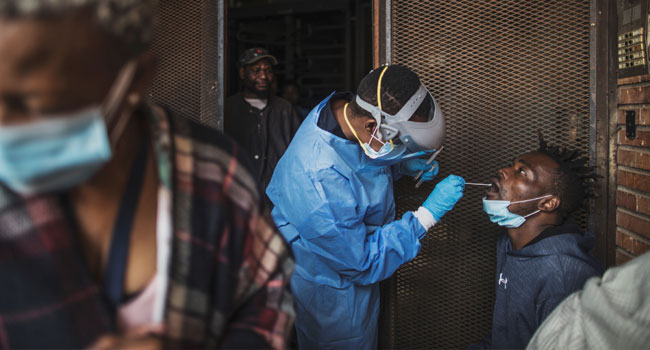 South
African public healthcare workers dispersed into the buzzing streets of
Johannesburg’s Yeoville neighbourhood as Africa’s worst virus-hit
country rolled out mass door-to-door testing for COVID-19.
South
African public healthcare workers dispersed into the buzzing streets of
Johannesburg’s Yeoville neighbourhood as Africa’s worst virus-hit
country rolled out mass door-to-door testing for COVID-19.
Armed
with screening questionnaires and testing kits, medics and volunteers
set up their testing station on the front porch of a block of flats in
the gritty business neighbourhood.
Nurse Xola Dlomo told AFP they were asking one resident to mobilise fellow flat dwellers to come for screening and tests.
“They’ve been coming for screening and they are even open to testing if they have symptoms,” Dlomo said.
Already
in a 21-day lockdown, South Africa is now embarking on the widespread
testing and quarantine campaign involving some 10,000 field workers who
are being sent out into homes in villages, towns and cities to screen
for symptoms.
The testing plan to break the chain of infection
appears to be modelled on the South Korean strategy which saw the Asian
country bring the outbreak under control.
South Africa has so far
reported nine deaths and 1,585 infections, but Health Minister Zweli
Mkhize has warned that the relatively small growth in numbers was
perhaps “the calm before a heavy and devastating storm”.
In
Yeoville — a crime-prone area in Johannesburg’s hardscrabble central
business district — eight small groups have been dispatched across an
area covering one square kilometre.
“The health of our people is our first consideration,” said Kegorapetse Ndingandinga, overseeing the Yeoville team.
– Scaling up Testing –
With his head tilted back, 58-year-old Michael Moshone, braced for his nasal swab, seated on a brick staircase in Yeoville.
“It
is a little bit uncomfortable but you’ve got to be strong… because you
want to know exactly what is going on with you,” Moshone, wrapped in a
green, gold and black scarf, said after his sample was taken.
Before
the rollout of mass screening and testing, more than 47,500 tests had
been performed, 6,000 of them at public health centres.
But for
the health minister, that number is too low for a country of 57 million
people where several million have underlying conditions such as HIV and
TB.
The turnout was slow on the first day on Friday, Dlomo said.
– Grim Reminder of HIV –
But for Moshone who has lived in the area for 26 years, the trickle of people is no surprise.
It reminds him of the early 1990s when HIV first emerged in the country, which now has the world’s highest HIV prevalence rate.
“In
South Africa, this thing is like HIV because when HIV started here… we
didn’t take it seriously until we saw people dying,” he said.
But
Dlomo is hopeful that visibility of health care workers in communities
will push people to realise “that this thing is serious and they need to
take precautions”.
World Health Organisation technical officer
Mary Stephen told AFP that based on how the virus has spread through
other countries, governments are urged to scale up public awareness,
surveillance and medical care.
South Africa’s public National
Health Laboratory Service (NHLS) has secured 67 mobile vans to ramp up
testing across the country.
Currently, the state will be able to
carry out 5,000 tests in 24 hours at 10 laboratories countrywide, but at
full capacity it can process 30,000 tests each day.
The country
is currently observing a 21-day lockdown patrolled by the police and
military, a perfect time to carry out the mobile testing, according to
the health minister.
But the lockdown is little respected in the densely-populated Yeoville.
“They
don’t want to isolate themselves inside their houses. They come out
with their kids, they don’t care,” said Masechaba Motaung, pointing at a
busy street.
“They take this virus as if there is nothing happening.”
Police
have used rubber bullets, teargas and whips to force people to maintain
social distancing and force people back into their homes.
Join Geezgo for free. Use Geezgo's end-to-end encrypted Chat with your Closenets (friends, relatives, colleague etc) in personalized ways.>>
Comments
Post a Comment