Fred Imbert
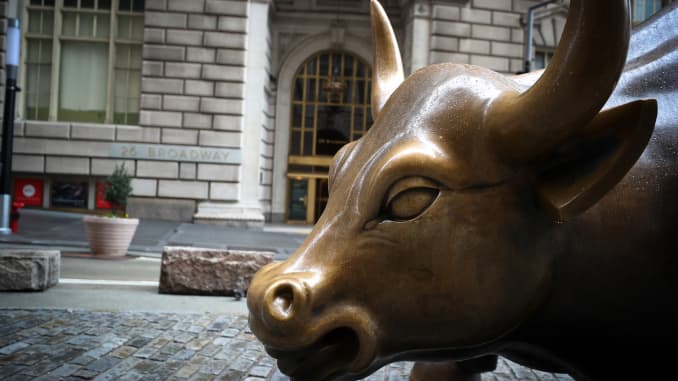
Charging Bull Statue is seen at the Financial District in New York City, United States on March 29, 2020.
Tayfun Coskun | Anadolu Agency | Getty Images
Stocks
futures fell on Sunday night, following oil prices lower,
while investors assessed the possibility of re-opening the global
economy after the coronavirus outbreak.
Dow Jones Industrial Average futures were down 47 points, or 0.2%.
S&P 500 and
Nasdaq 100 futures slid 0.4% and 0.2%, respectively. West Texas Intermediate futures were down 2.4% at $16.53 per barrel.
Wall
Street’s coming off its first weekly decline in three as a record
plunge in oil prices sent investors for a wild ride. Both the Dow and
S&P 500 fell over 1% last week while the Nasdaq Composite dipped
0.2%.
New York Gov. Andrew Cuomo said Sunday the state plans to
re-open its economy in phases. The first phase, Cuomo said, would
involve New York’s construction and manufacturing sectors. As part of
the second phase, businesses will need to design plans for a re-opening
that include social distancing practices and having personal protective
equipment available.
Cuomo also noted that
coronavirus-related hospitalizations have fallen for 14 days and that virus deaths in New York hit a near one-month low.
Those comments came as Georgia started to re-open its economy.
“As
various states begin to reopen their economies and relax social
distancing rules, we will get a glimpse of what the new normal looks
like,” said Marc Chaikin, CEO of Chaikin Analytics. “The biggest risk to
the stock market is a premature reopening of the U.S. economy which
results in an increase in COVID-19 cases and requires an abrupt reversal
of these efforts to awaken the economy out of its engineered coma.”
Shelter-in-place
orders and social distancing guidelines forced thousands of businesses
to shut down starting in March as the federal and state governments
tried to contain the coronavirus outbreak. Nearly 3 million cases have
been confirmed worldwide with over 900,000 in the U.S., according to
data from Johns Hopkins.
The outbreak, and subsequent business closures, sparked a wave of job losses. Data from the Labor Department shows that
more than 26 million people have filed for unemployment benefits over the past five weeks.
To
be sure, a decline in new virus infections and unprecedented monetary
and fiscal stimulus have sparked a massive stock-market rally from the
lows reached on March 23. Since then, the major averages are all up more
than 20%, with the S&P 500 retracing about half of its decline from
a record set Feb. 19.
Investors have also cheered the
prospects of Gilead Sciences’ remdesivir as a potential treatment for
the coronavirus. On April 16, STAT News reported patients at a Chicago
hospital with severe coronavirus symptoms were quickly recovering after
being treated with the drug in a trial.
A Financial Times report
on Wednesday quelled some of that excitement, however, as it stated
remdesivir did not improve patients’ condition during a trial in China.
Gilead pushed back on the report and the study it cited, noting the
trial was “was terminated early due to low enrollment,” making it
“underpowered to enable statistically meaningful conclusions.”
“This
drug has become the single most important macro topic/theme/trend in
the entire market,” Adam Crisafulli, founder of Vital Knowledge, said in
a note. “Investors are dismissing the “flop” headline from the FT and
continue to anticipate positive results of some kind out of (at least)
one of the many Remdesivir trials now underway (while FDA approval is
widely assumed).”
“The present setup is such that Remdesivir
anticipation will very likely be more beneficial/powerful than the
actual results themselves (the data most likely will show efficacy to
some extent in certain instances, but a medical “silver bullet” isn’t
about to emerge),” Crisafulli added.
Join Geezgo for free. Use Geezgo's end-to-end encrypted Chat with your Closenets (friends, relatives, colleague etc) in personalized ways.>>
Comments
Post a Comment