When US Secretary of State
Mike Pompeo
arrives in Jerusalem on Wednesday, there will be a long list of topics
on the agenda, many of which are issues on which Israel and the Trump
administration currently see eye-to-eye, like settlement annexation and
Iran.
But there’s one matter that’s sure to come up, which is more contentious than the others: Growing Chinese investments in Israel.
Friction between the US and
China
has been on the rise for years – after all, US President Donald Trump
announced a trade war on China in 2018 – but it has gotten much worse in
the wake of COVID-19, with the sides trading barbs and blaming one
another.
This adds up to bad news for Israel, leaving it caught between two countries with which it has extensive ties.
The
best-known point of contention between the US and Israel is a new
terminal in the Haifa Port, partially constructed and to be operated by a
Chinese company next year.
More recently, there has been
growing attention paid to Sorek 2, which will be the world’s largest
desalination plant. Hutchison Water International, a subsidiary of a
Hong Kong-based company, is one of the two finalists for the tender to
operate the plant. On Tuesday, Channel 13 reported that Prime Minister
Benjamin Netanyahu ordered the committee on foreign investments to
reassess the tender, due to American pressure.
US Ambassador David Friedman told
The Jerusalem Post last week that “the last thing we want is any limitation on how the US can do business or cooperate in Israel.
“For
two countries as close to each other as Israel and the US, when they
cooperate and exchange intelligence and other secrets for their mutual
protection on such a robust level, both countries need to be really
careful about exposing that level of cooperation to a foreign power that
may have a different agenda,” he said.
Friedman warned that China uses its investments and infrastructure projects to “infiltrate” countries.
“They
crept up on the entire world in a benign but dangerous way. They didn’t
do it with rockets and tanks; they did it with cheap labor projects,”
he added, saying that “these [Chinese] companies have the ability to
flick various switches and gain access to the most sensitive
communications.”
Israel-China trade grew by 402% in the past
decade, reaching about $14 billion in 2018, making China Israel’s
third-largest trading partner.
Beijing’s Belt and Road
Initiative, launched in 2013, set a goal for China to take part in
infrastructure projects around the world. In 2015, China’s leadership
also launched “Made in China 2025,” meant to turn the country into a
global high-tech manufacturing leader. Israel fits into both of those
objectives.
Israel’s motivation, beyond getting much-needed
capital, is to diversify its export markets and sources of investment by
plugging into the world’s fastest-growing economy. There are major
advocates of a stronger relationship with China in Israel’s government,
going all the way up to Prime Minister Benjamin Netanyahu.
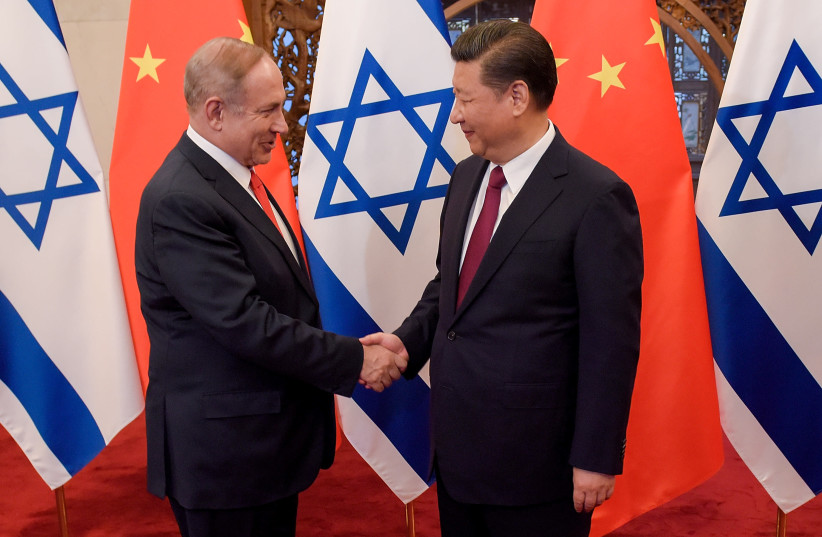
Visiting
Beijing in 2017, Netanyahu told Chinese President Xi Jinping that China
should “assume its rightful place… on the world stage,” and said Israel
is “your perfect junior partner for that effort.” He added that
China-Israel trade “is a marriage made in heaven.”
RAND, a
prominent think-tank funded partly by the US government, published a
comprehensive report last month, sponsored by the Office of the US
Secretary of Defense, titled “Chinese Investment in Israeli Technology
and Infrastructure: Security Implications for Israel and the United
States.”
According to the report, the US should be most
troubled by Chinese investment in Israeli technologies that could give
China a military and economic edge, but it also warned against too much
foreign investment in Israel’s vital infrastructure, which, if damaged,
could lead to substantial economic, social and environmental losses, and
even casualties.
The RAND report identifies 11 companies
that should raise concerns for Israel or the US, involved in major
transportation infrastructure projects worth over $4b. – expanding the
Ashdod Port, building and operating the new Haifa Port terminal and the
Tel Aviv light rail, digging the Carmel Tunnels in Haifa and
potentially, a railway line between Eilat and the Mediterranean Sea – or
investing in “dual-use” commercial technologies that could have
military or intelligence functions.
One of the risks is that
most of the Chinese companies in question have strong links to the
Chines e government, military or Chinese Communist Party. For example,
China Communications Construction Company and its subsidiaries, like
China Harbor Engineering Company, worked with the Chinese armed forces
and the Ashdod Port, plus the proposed Eilat rail line. Chinese tech
companies like Huawei and ZTE that have invested in Israel “have come
under significant scrutiny in the US for their less-than-transparent
connections to the Chinese government and military,” the report states.
Chinese
investments and construction activities could pose cybersecurity and
intelligence threats. Huawei, Xiaomi, ZTE and other investors in Israel
sell products known to have security vulnerabilities. Chinese companies
have shown an interest in dual-use technologies, in areas like
artificial intelligence, satellite communications and cybersecurity.
Israel limits export of dual-use items, but it has identified many of
these technologies as commercial, despite their security risks. RAND
raised concerns about cyber-espionage, saying that technological
information can be “used by China to bolster its own cyber defenses or
reverse-engineered to ID software vulnerabilities.”
But
concern about spying is not limited to the tech sphere. The report
posits that physical proximity is a potential risk and that human
intelligence-gathering efforts will probably grow as more Chinese
personnel is sent abroad. For example, if a US Navy ship comes into the
Haifa Port, as the 6th Fleet does at least once a year, Chinese
operatives could try to identify its electronic warfare capabilities,
the signatures it emits or what radars are on board.
The RAND
report also pointed to incompatibility between Israeli and Chinese
interests in the Middle East, particularly Beijing’s close ties with
Tehran. China has supplied hundreds of millions of dollars in weapons to
Iran since 2000, has cooperated with Iran’s missile and nuclear
programs and opposes military action against the Islamic Republic. Of
the companies working in Israel, ZTE and China Railway Tunnel Group also
did business with Iran.
China’s foreign policies go against
Israel’s interests in other ways as well. China does not recognize
Hezbollah as a terrorist group, and Israel has advocating for countries
to do so. China also votes against Israel at the UN.
Then,
there’s concern for the US-Israel relationship. The US is the lynchpin
of Israeli foreign policy, and those close ties are one of Israel’s
greatest strategic assets. A threat to security and intelligence
cooperation between Israel and the US is a serious one.
In
addition, getting on the wrong side of the trade war with China could
also be problematic, as a Trump administration official signaled. The
official said Trump was “dead on” about China’s trade deficit with the
US in his 2016 presidential campaign.
“Israel can use domestic
labor or labor from the US or another ally,” the US official said. “In
the long run, we’ll be there for Israel, and China won’t.”
The
second and final part in this series will report why US warnings are
likely to increase, and how Israel needs to institute better oversight
to allay American concerns – and for its own security.
Comments
Post a Comment