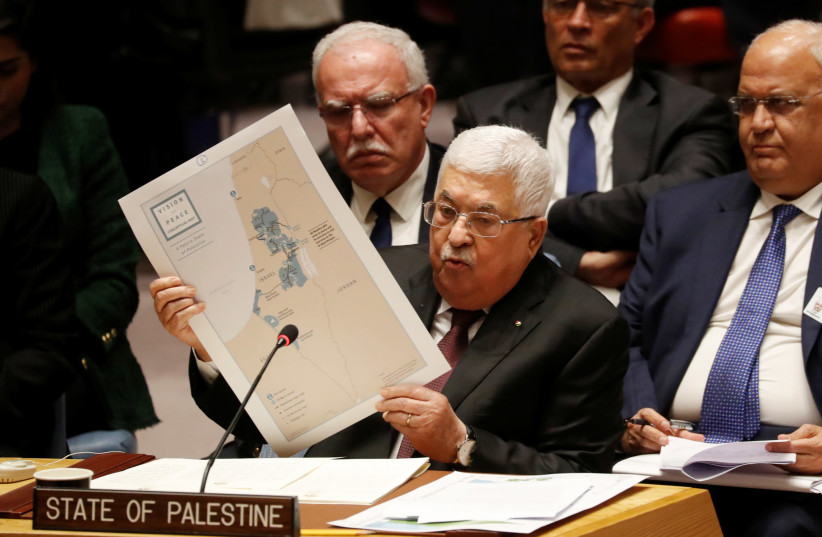
The Palestinians have turned to the UN to halt Israel’s pending
plans to annex West Bank settlements, with a Security Council discussion
on the matter expected to be held on May 20.
Palestinian envoy to
the UN, Riyad Mansour, said the Palestinians were seeking a “wide and
powerful front in the UN to prevent Israel from annexing parts of the
West Bank.”
Mansour said the Palestinians sent letters to the UN
Security Council and General Assembly regarding Israel’s “illegal plans
concerning settlements and
annexation.” He said he expected the Security Council members to discuss the Israeli plan during the council’s session on May 20.
Earlier
this week, the “Arab Troika” in New York, under the chairmanship of
Oman, met with UN Secretary-General Antonio Guterres and warned him
about the repercussions of the Israeli plan.
“The Arab delegation
emphasized the illegality of all colonization and annexation measures by
Israel, the occupying power, and strongly condemned Israel’s plan to
annex large areas of the West Bank in grave violation of the Fourth
Geneva Convention, UN resolutions and the charter prohibiting the
acquisition of territory by force,” the Arab group said in a statement.
“They
deplored Israel’s cynical exploitation of this period of global
pandemic to advance these illegal plans, and underscored the
international community’s broad rejection and demands for a halt to
these illegal actions.”
The Arab delegation warned that Israel’s
actions “are severely violating the Palestinian people’s rights and
destroying the viability of the two-state solution on the pre-1967
borders.” The Arab delegates also warned that, if not stopped, Israel’s
“illegal actions would result in a one-state reality, bringing only more
conflict and suffering and impeding prospects for peace and security in
the entire region.”
In Ramallah, Palestinian Authority President
Mahmoud Abbas was scheduled to chair a meeting of the PLO Executive
Committee on Thursday night to discuss Israel’s plan to apply
sovereignty to parts of the West Bank.
This would be the second meeting of its kind during the past few days to discuss the plan.
Earlier this week,
Abbas
chaired a meeting of the Fatah Central Council and again threatened to
renounce all signed agreements with Israel in response to the annexation
plan.
PLO Secretary-General Saeb Erekat said Thursday’s meeting
would discuss the need to take a series of decisions to confront the
Israeli plan. Erekat called on the international community to prevent
Israel from proceeding with its plan.
Separately, Prime Minister
Benjamin Netanyahu is under pressure from the settlers to move forward
on the plans immediately, particularly now that the High Court of
Justice ruling that gave a stamp of approval for his premiership.
Netanyahu
should “announce in front of Knesset that he will now seek to promote
the application of Israeli law in Judea and Samaria,” Efrat Council head
Oded Revivi said.
“This declaration, alongside a written
timeline, will result in a greater commitment from the new government
that is forming. It is equally important for everyone to understand that
the application of sovereignty will occur,” he added.
“Netanyahu
will speak in favor of the application of sovereignty, and after his
speech, an overwhelming majority of Knesset members will vote for it.
This will mean that even in this political arena, both the national and
international communities will internalize and accept the Israeli
decision that will come from the consensus of a broad government,”
Revivi said.
The pressures comes on the heels of US Ambassador to
Israel David Friedman suggesting the US was ready to back the plans and
that negotiations between Israel and the Palestinian Authority should
resume.
“As a new government is formed, it would be appropriate
for [support for the Trump plan] to be re-upped by the leader and then
to proceed in good faith on that basis,” he told The Jerusalem Post
earlier this week.
Friedman’s remarks drew attention in the US, as
well. Martin Indyk, former ambassador to Israel and envoy to the
Israeli-Palestinian negotiations, tweeted: “Pied Piper Friedman leading
Israel off a cliff, with Bibi playing the big drum and [Blue and White
leader] Bennie [Gantz] the timbrel and the rest of us too disillusioned
or distracted to do anything about it.”
J Street, the progressive
Jewish group, similarly slammed Friedman. a J Street spokesperson said
“it’s been clear for years that Ambassador Friedman – a longtime
benefactor and advocate for the settlement movement – sees it as his
personal mission to encourage illegal, unilateral Israeli annexation in
the West Bank.
“As he indicates in this interview, the entire
Trump plan is simply a vehicle to provide an American green light
annexation under the false pretense of supporting negotiations towards a
two-state solution,” J Street spokesperson added. “But no matter what
[US President Donald] Trump and Friedman say, the truth is that
annexation would be a disaster for the long-term interests of Israel and
the United States–which is why it’s strongly opposed by the Israeli
security establishment, the majority of Israelis and responsible
lawmakers here in the US.”
The Israel Policy Forum released a
scathing statement as well. “We are disappointed that Benny Gantz has
agreed to this step as a condition for forming a unity government, not
least because it is a departure from his previous statements and stances
on the subject of West Bank annexation,” the statement read.
“We
hope that the new Israeli government closely examines the potential
consequences of unilateral annexation and the deleterious impact it will
have on Israeli security and diplomacy and that it heeds the warnings
against unilateral annexation that have come from Israeli security
experts, the United States Congress, the European Union, foreign policy
experts and American Jewish leaders,” the organization added. “As
Israel’s year of political instability now comes to a close, we urge
Israel’s leaders not to take any steps that may put its future stability
at risk.”
Israeli Ambassador to the UN Danny Danon said that "The
Palestinians are continuing their policy of negation and obstinance.
Instead of futile and irrelevant actions, they should return to direct
negotiations. Any decision to apply sovereignty will be made in
Jerusalem by the Israeli government, and nowhere else."
Lahav Harkov contributed to this report.
Comments
Post a Comment