By LAHAV HARKOV9-12 minutes
Part II: Why US warnings are likely to increase, and how Israel needs better oversight to allay them – and for its own security.
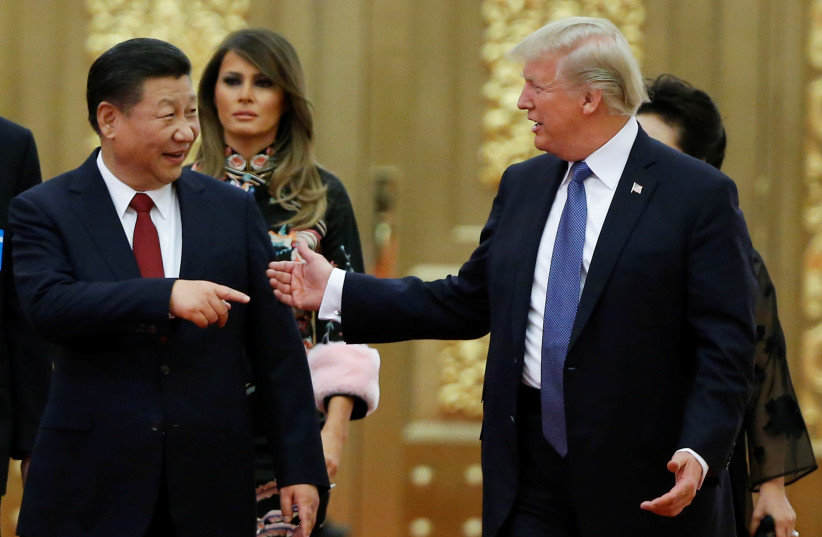
US President Donald Trump and China's President Xi Jinping arrive at state dinner, Great Hall of the People, Beijing, 2017.
(photo credit: THOMAS PETER/REUTERS)
US-China ties have hit another low point in the wake of
coronavirus. US President Donald Trump rails against China in his daily
press conferences, pointing to a cover-up of information about
coronavirus when the outbreak began and to a hypothesis from US
intelligence agencies that the virus was accidentally released from a
laboratory in Wuhan. Chinese officials have spread unfounded theories
about COVID-19 originating in the US or Europe, messages taunting the
West as weak and videos mocking the American response to the virus. And
this is after two years of a trade war.
Meanwhile, Israel is
dealing with continued pressures from the US over Chinese investments in
Israeli technology and infrastructure.
US Secretary of State Mike
Pompeo sprung some of that pressure on Prime Minister Benjamin
Netanyahu in their statements to the press ahead of their
meeting in Jerusalem
on Wednesday, when he spoke of American and Israeli cooperation
fighting the coronavirus pandemic and then commented: “You’re a great
partner, you share information, unlike other countries that obfuscate
and try to hide that information – and we’ll talk about that country,
too.”
As reported in
part I of this series,
the US has long been concerned with China using investments in Israeli
innovations to give itself a military and technological edge, as well as
Beijing’s ability to gather intelligence, whether by taking advantage
of cybersecurity weaknesses, reverse-engineering technology to which it
gains access, or physical proximity to sensitive areas by Chinese
operatives on infrastructure construction sites. In response, Trump and
Pompeo said last year that intelligence sharing with Israel could be
reduced if they are not given reassurances that these concerns have been
taken care of.
Dr. Shira Efron, a visiting fellow at the
Institute for National Security Studies and one of the authors of a
report by the RAND think tank titled “Chinese Investment in Israeli
Technology and Infrastructure: Security Implications for Israel and the
United States,” projected this week that tensions in the US-Israel-China
triangle will intensify in the aftermath of COVID-19.
“Even
though the Chinese economy was hurt substantially, China has very unique
financial measures, because it is not really an open economy. It can
lend heavily to banks it owns and subsidize companies, so it looks like
China is emerging from the crisis a little bit stronger economically,
relative to the US and Europe,” she explained.
Plus, Efron pointed
out that the US and EU are looking inward and calling for people to buy
locally-manufactured products, while China’s economy is dependent on
making investments abroad.
This is significant for Israel, because
it would likely mean that the Chinese share of foreign investments in
Israeli companies will grow. Efron explained that “if US and EU
investors don’t have any money, we’ll see more Chinese investments here…
If start-ups need the capital, they’ll go with whatever they can get.”
EFRON
IDENTIFIED public health, medical technology and biotechnology as
sectors China will likely target following the COVID-19 pandemic.
Biomedical and high-performance medical equipment are among ten priority
sectors for the Beijing in its Made in China 2025 project, meant to
turn the country into a global high-tech manufacturing leader. The RAND
report identified over a billion dollars in Chinese investments in the
Israeli health and biomedical sectors in the years 2013-2018.
“Israel
views these as totally kosher and purely civilian, but the EU issued
guidance to its members in late April to be more protective about
investments in public health companies. In the US, CFIUS [the Committee
on Foreign Investments in the US] monitors these investments with much
more scrutiny,” Efron said. “Medical security is also national
security.”
One major concern about Chinese investments in this
area is the collection of people’s medical data. Last month, Israel’s
Defense and Health ministries signed a NIS 90 million (over $25m.)
contract with Beijing Genomics Institute (BGI), the world’s largest DNA
and genetics company, for coronavirus testing and processing equipment.
Clalit, Israel’s largest HMO, decided against working with BGI, due to
its ties with the Chinese government and a concern that it could access
medical information of nearly five million Israelis, including their
DNA.
The US would also be concerned about Chinese investments in
this area because of supply chain vulnerability, meaning that it seeks
to be more self-sufficient in this area and encourages its allies to be,
as well. Even before the shortage of personal protection equipment and
coronavirus tests in the US, New Jersey, once a pharmaceutical
manufacturing hub, lost many of those jobs to China.
A Trump
administration official said: “Our concern about China doubled and
tripled because of coronavirus... We realized that we’re the richest,
strongest, most powerful country in the world,” but that America was not
able to get enough personal protective equipment and testing kits,
because “we offshored cheap labor and can’t get it back when we need it.
“We
offloaded all the manufacturing jobs to China because they provide
cheap labor, and we hurt ourselves. We’ll have to pay a little more for
things now to have control over them,” he said – and called on Israel to
do the same.
Efron concurred, saying that: “Every country should be able to safeguard the public health of its own population.”
WHAT
CAN Israel can do to allay tensions with the US over China? It can
create a regulatory environment that properly reviews the security risks
these investments may pose.
US Ambassador to Israel David
Friedman called for Israel to have a more comprehensive system for
regulating foreign investments, expressing hope that the new government
would do more towards that end.
“There is a robust system of
protecting any foreign investment in the US,” he said, referring to
CFIUS. “I wouldn’t say right now that Israel is at that level.”
Europe and Canada have similar committees on foreign investments, which Efron posits is a euphemism for China.
In
theory, Israel has dealt with this issue. Following US pressure, the
Prime Minister’s Office announced on October 30, 2019, that it would
form an advisory committee to “find the appropriate balance between the
need to encourage foreign investments in Israel and ensure continued
economic prosperity, and considerations of national security.”
Representatives of the Finance and Defense ministries and the National
Security Council are members, and there are observers from the Foreign
Ministry, the Economy Ministry and the National Economic Council.
“This
is a step in the right direction. However... in practice, the committee
might not fundamentally change the regulation environment,” the RAND
report argued.
The committee has a number of weaknesses, foremost
of which is that its recommendations are non-binding and it does not
have the power to cancel deals.
It is also voluntary, meaning that
regulators in different fields can choose whether to bring a potential
investment before the committee. In addition, investments that don’t
already need government approval won’t be brought to the new committee
at all.
The committee’s establishment is not anchored in
legislation, but in a security cabinet decision. This means there is
almost no transparency about its membership or mandate, and none at all
about its meetings, all things that lawmakers may have tried to require.
The committee only gives advice on investments in finance, communications, infrastructure and energy.
CFIUS
can review investments in technologies that are “critical, emerging and
foundational,” the US Department of Treasury says. This includes
biotechnology, artificial intelligence and machine learning, navigation,
data analytics, robotics and microprocessors, all of which can be
considered dual-use technologies.
Not one of those areas is
included in the Israeli committee’s purview, which excludes the tech
sector, even though the majority of Chinese investments in Israel in the
last decade fall into those categories.
The committee’s narrow
mandate, despite calls from the security establishment to institute
stricter regulations, comes from concerns in the business and economic
sectors that its existence would antagonize China and reduce its
investments in Israel.
Efron says that all of these weaknesses in the committee have piqued American concerns.
“It’s
not clear that the Americans are getting straight answers about what
the committee actually does,” she explained. “This is like a test case.
Israel needs to show the US that we care about their concerns.
Relationships are a give and a take; we need to show that we’re
listening.”
The RAND report co-author suggested that Israel take this committee seriously and not only do it to satisfy the Americans.
“We
need to examine the long-term implications of foreign investments from
China – or any other country – on our national security. There are
actual risks; it’s not just about not wanting to make Trump angry,” she
said.
Join Geezgo for free. Use Geezgo's end-to-end encrypted Chat with your Closenets (friends, relatives, colleague etc) in personalized ways.>>
Comments
Post a Comment