A lot of what I write is about measurement, not because I'm
in love with calipers, but because the cutting edge of physics is at the
limit of what we can measure. That means that when you want to think
about what to do next, you need to consider how a measurement can be
made more sensitive.
Many people, including some scientists, don't realize that
you can learn a lot about the world simply by developing new or better
instruments. Today, I've decided that the measurement you all need to
know about is interferometry. Why? Because interferometers are the
fezzes (fezzes are cool) of the physics world. And now, a group of international researchers has come up with a way to make interferometers even more sensitive.
To understand why this is significant, you need to
understand why I'm not kidding about interferometry being cool. In the
past, an interferometer at a Laser Interferometer Gravitational-Wave Observatory (LIGO)
was used to detect gravitational waves. The experimenters at LIGO
worked hard to gain control over every aspect of the experiment (except
for the gravitational waves—they had no control over them), including
exquisite control over the light source used. In the end, their results
involved measuring physical movements that were less than the diameter
of a proton. Surely, very few measurement problems would require an even more sensitive interferometer.
But consider astronomy, where interferometry is used to make measurements on light itself.
In this case, the light that nature gives you is dim and has properties
not conducive to high-quality measurements. Interferometry under these
conditions is challenging.
Have you seen my fez interferometer?
Before I get to the new stuff, let me introduce you to the
wonderful world of interferometry and what it has given us.
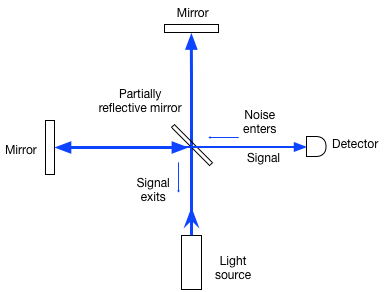
Interferometry is just a way to compare light to itself. You have a
source of light, which you pass through a partially reflecting mirror.
The reflected part of the beam travels to a second mirror, is reflected,
and returns to the first. Likewise, the transmitted part of the beam
reflects off yet another mirror and returns to the partially reflective
mirror.
Once back at the partially reflective mirror, the two light
beams interfere and leave the interferometer. Notice in the picture that
the light leaves the interferometer in two directions, but only enters
in one. The other direction (or "port" as it is called) also takes in
light, but that light has no intensity. Nevertheless it contributes to
the signal by adding noise.
Enlarge/
Interferometer: light enters the interferometer at the bottom. It is
divided by the partially reflective mirror. Half the light travels to
the mirror on the left and half continues up to the mirror at the top.
These two mirrors reflect the light, which recombines at the partially
reflecting mirror. The recombined light either exits in the direction in
which it came, toward the detector, or a combination of both. This is
symmetrical, so light can also enter from the detector side as well.
Even though this light has no intensity, it adds noise.
Imagine that the interferometer is perfectly balanced (so
the distance from the partially reflective mirror and the end mirrors is
the same for both paths), and the end mirrors are identical. All the
light will go in a single direction and the other direction will be
completely dark. You can use an interferometer to test whether a
mirrored surface is polished and nearly perfectly flat—just use it at
one of the end points. Likewise, if you need to make a mirror that has a
specific curvature, then the output from the interferometer can tell
you exactly how accurate your curvature is. How accurate? Using
interferometry, professional optics manufacturers can figure optics with
an accuracy that is less than the diameter of an atom.
It's also easy to improve these systems. The more accurate you need
to be, the brighter you make the light in the interferometer. This is
one of the keys to LIGO's success: the optical power in the
interferometer was many kilowatts—signal swamping noise.
Turning the brightness down
Brightness is so effective because of its relationship with
noise. For a laser, the noise increases with the square root of the
average power. So, if you quadruple the average power of your laser, the
noise only increases by a factor of two, giving you a net win. But
starlight isn't a laser—it's thermal light. For thermal light,
increasing the average power does not give you a net win, because the
noise is equal to the average power, at least for bright sources. For
dim sources, the random fluctuations are actually greater than the
average power.
Given this, you might think that subtracting even more light
from the output of an interferometer would make measurements more
difficult. But this is exactly what the new work I mentioned earlier
involves. And subtracting light works: it makes the interferometer more
sensitive. Why? The answer lies in how you use the subtracted light.
For a very dim thermal source, most of the time there are no photons.
If you could somehow measure only when there are photons, then you
remove a portion of the fluctuations. This is exactly what researchers
have done.
At the output of their interferometer, they place a
partially reflective mirror that allows them to remove a chosen number
of photons. They place a detector in the path of the reflected light to
look for those photons. Whenever the detector clicks, they know that
there was at least one photon in the interferometer. They can then
choose to measure the output of the remaining light from the
interferometer.
This sounds simple. Indeed, in electronics, this would be
referred to as a box-car integrator. If you have a short signal that
comes with a triggering event, you can choose to measure in the tiny
interval when the signal is there. Add up the output from all those tiny
intervals, reject the noise from all the time in between, and you have a
much cleaner signal.
But doing this with photons is complicated because of the statistics of light's behavior.
Photons of a feather flock together
For our purposes, the interferometer accepts light that is
in specific modes. Think of modes as a categorization of different
photons: wavelength, spatial distribution, electric field orientation,
and so on. When we measure the intensity of the light (including at the
output of the interferometer), we are asking how many photons are in a
particular mode in a particular time interval. And most of the time, for
dim light, the answer is zero.
But the statistics of photons are a bit weird, because
photons are more likely to arrive in bunches, rather than separately.
Why is this? Here's a simple way to think about it: a photon is also a
wave and has a spatial extent. Now, if two photons with the same color
are traveling together, then they add up in phase to create a brighter
light. But, if one photon slips backward with respect to the other, the
light gets dimmer and dimmer until it almost vanishes due to
interference.
As a result, for a light source above a certain brightness,
the probability of measuring two photons arriving at the same time is
not just non-zero but is higher than that of individual photons—and
much, much, much higher than for two photons that are separated in time
by exactly half a wavelength. Essentially, the mixing of the wave-like
nature of photons ensures that they travel in little bunches that are
well separated from each other. All those photons that would find
themselves between these bunches suffer destructive interference and are
never emitted.
Because photons are more likely to travel in groups, finding one
photon means that there is probably another. Finding two photons means
that there is likely a third or fourth to be detected. In other words,
if we use the box-car integrator analogy, the trigger signal can be
tuned to only measure the interferometer output at those moments when
there is the highest number of photons in the mode.
As a result, you get a complicated relationship. Subtracting
a single photon improves the ratio between the signal and noise by
about 1.4. But subtracting two photons increases the signal-to-noise
ratio even further. This increase happens because, by upping the
threshold, you only look for those moments when the output intensity
will be increasingly high. And the statistics of photons ensure that
these moments occur a bit more often than a naive estimate would lead
you to expect, which gives you a small net win.
Hurry up and wait
However, don't think you are going to win too much by
subtracting light. Imagine that you crank up the threshold so that you
don't make any measurements until there are ten photons. For a very dim
light, you are going to be waiting a very long time to trigger on a
single event. In other words, just like every other measurement in
existence, you face a trade-off between measurement time and signal
clarity. In this case, the trade-off is more stringent, because the
measurement device spends more and more time not actually measuring
anything.
Nevertheless, in situations where you can sacrifice time to get a better signal, this may well be worth it.

Comments
Post a Comment